

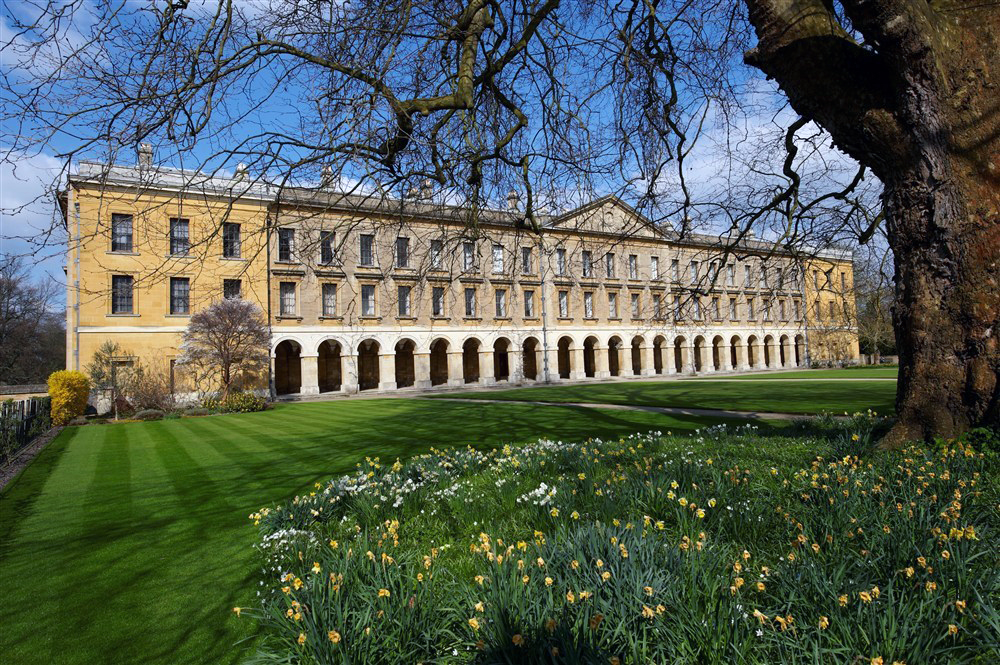
College Life at Magdalen CollegeOxford Colleges usually house an atmospheric Dining Hall, Chapel, tutors’ studies, specialist teaching, library and IT facilities, public rooms and administrative offices, located alongside central but often older student study-bedrooms – all reflecting the medieval origins of Oxford’s collegiate system.
Summer School students are housed either in individual study-bedrooms with en-suite facilities, or in small clusters of larger individual study-bedrooms sharing bathroom facilities. All rooms have internet access and also normally share additional kitchen and common room (lounge) facilities with a number of other students.
Summer School Programme fees cover the comprehensive cost of tuition, library access, accommodation and all weekday meals (with a more limited meals service at weekends) and day excursions. Fees also include several receptions for guest speakers, tutors and students and bag lunches are provided for excursions and field visits.

After the end of the Summer School, a formal Report of your attendance, Course Option and awarded grade together with your tutor’s comments is sent to your University with a printed copy for you too.

Magdalen College is beautifully situated just a short stroll from the heart of Oxford, close to the iconic Bodleian Library and the stunning Magdalen Tower. Our college offers easy access to faculty libraries, lecture halls, charming bookshops, and inviting cafes. You’ll reside in our picturesque south Oxford accommodations, nestled near the River Cherwell, perfect for those looking to join our vibrant college rowing clubs.
In addition to its rich tradition of academic excellence, Magdalen is renowned for its stunning architecture, particularly the iconic Great Tower. The college is also celebrated for its welcoming community and expansive grounds, which feature a deer park, a Water Meadow, and the scenic Addison’s Walk.
Magdalen College, founded in 1458 by William Waynflete, Bishop of Winchester and Lord Chancellor, was established on a grand scale, featuring 40 Fellows, 30 scholars (known as Demies), and a large choir. By the time of Waynflete’s death in 1486, the college boasted substantial income, impressive buildings, and a solid set of statutes.
Quickly becoming one of Oxford’s leading colleges, Magdalen welcomed notable visitors such as Edward IV, Richard III, and James I, and produced distinguished alumni, including Thomas Wolsey, chief minister to Henry VIII.
Throughout the Reformation and the English Civil War, Magdalen maintained its Royalist stance, suffering purges after Parliament’s victory. A pivotal moment occurred in 1687 when James II attempted to impose a President on the college. The Fellows’ resistance sparked national outrage, leading to their reinstatement, though James was soon deposed.
The 18th century saw a decline in Magdalen’s prestige, epitomised by Martin Routh, President for 63 years, who became a symbol of complacency. However, the college rebounded in the 19th century with scholars like Routh and Charles Daubeny, who established the Natural Science honours school, and John Bloxam, who revived the May Morning tradition.
In the 20th century, Magdalen’s academic reputation flourished, featuring prominent Fellows like C.S. Lewis and A.J.P. Taylor, along with ten Nobel laureates. Women were first admitted in 1979, and today, the college is committed to inclusivity and openness.
St Edmund Hall (or “Teddy Hall” is approximately 2 minutes walk from Magdalen College – so students housed here will still have their meals and tuition located at Magdalen. The beauty of Teddy Hall is an older, more intimate college, a few hundred yards down the Oxford High Street. Oxford colleges bring together everything you need for study and community: a historic Dining Hall and Chapel, tutors’ studies, specialist teaching rooms, library and IT facilities, common rooms and administrative offices. Student bedrooms are located this year at Tamesis House, located on Iffley Rd, Oxford OX4 1ED – this is a 2 minute walk or 500m distance from Magdalen College. Almost all rooms have a single bed with mattress, a bed-side cabinet, chest of drawers, desk, desk chair, easy chair, coffee table, wardrobe/hanging space for clothes, desk lamp, book shelf, IT socket, curtains/blinds, and en-suite or shared bathroom facilities. St Edmund Hall itself sits just steps from Oxford’s High Street, close to the Bodleian, neighbouring colleges, bookshops and cafés. Much of college life gathers around the Front Quad, where you’ll find the Porters’ Lodge, the 17th-century Old Dining Hall, the college bar (the Buttery), the Chapel and the Old Library. The Chapel (1682) houses early stained glass by Edward Burne-Jones and William Morris and supports an active chapel choir; above it, the Old Library hosts events, while the main library is the beautifully converted church of St Peter-in-the-East, complete with a 12th-century crypt and a quiet garden.
In the centre of the quad, a medieval well bears the inscription “Haurietis aquas in gaudio de fontibus salvatoris”—“with joy, draw water from the wells of salvation”—a reminder of the Hall’s deep roots. Over the Queen’s Lane entrance, the coat of arms and the dedication “Sanctus Edmundus huius aulae lux” (St Edmund, light of this Hall) signal a distinct identity shaped across centuries. Tracing its teaching life to the 13th century, St Edmund Hall is widely regarded as the oldest surviving academic hall at Oxford and the only medieval hall to endure as a college; since opening its doors to women in 1979, it has become known for an inclusive, welcoming community—Aularians, as members are called, take pride in this living medieval tradition.
Tamesis House (pictured right) is an official University residence, part of St Edmund Hall College, located 500m from Magdalen College (where all of our teaching and meals are located) it is situated over Magdalen Bridge up the Ifley Road. Students located here will benefit from a short walk into College and will enjoy all of the same access and experience as our other students. Around 25% of our summer school students this year will reside here and as is a more modern, 20th Century building.
© Oxford Academic Summer School Tours Ltd: for 2026, Oxford Summer School at Magdalen College, University of Oxford
We offer great services to our clients
Magdalen College
Lorem ipsum dolor sit amet, consectetur adipiscing elit. Donec eros elit, pretium et adipiscing vel, consectetur adipiscing elit.
See All Features